


If you're wondering, is Illinois a compact nursing state? The short answer is no. Illinois is not currently a member of the Nurse Licensure Compact (NLC), which means nurses licensed in Illinois cannot use one license to practice in other compact states.
Whether you're planning your next travel assignment, considering relocating, or simply exploring your options, understanding Illinois' licensing rules can help you avoid delays and prepare for opportunities across state lines. Here's what you need to know.
Table of contents
- What is the Nurse Licensure Compact (NLC)?
- How does the NLC benefit nurses?
- What are the compact states for nursing?
- What states are not compact states for nursing?
- So, is Illinois a compact nursing state?
- What this means for nurses in Illinois who want to work across state lines
- What this means for nurses who want to work in Illinois
- FAQs
What is the Nurse Licensure Compact (NLC)?
The Nurse Licensure Compact (NLC) is an agreement that allows registered nurses (RNs) and licensed practical/vocational nurses (LPNs/LVNs) to practice in multiple participating states with one multistate license. Instead of applying for a separate nursing license every time you want to work in another compact state, eligible nurses can practice across state lines without obtaining additional licenses as long as they maintain legal residency in a compact state.
The NLC is designed to make it easier for nurses to respond to workforce shortages, accept travel assignments, provide telehealth services, and pursue new career opportunities with fewer administrative hurdles.
How does the NLC benefit nurses?
The Nurse Licensure Compact offers several advantages, especially for nurses who value flexibility. Benefits of the NLC include:
More career freedom: Travel and per diem nurses can accept positions in participating states without waiting weeks or months for additional licenses.
Less paperwork and lower costs: Maintaining multiple single-state licenses can become expensive and time-consuming. A multistate license helps reduce licensing fees and renewal requirements.
Faster job starts: When employers need nurses quickly, having a multistate license can help you begin working sooner in eligible states.
Expanded job opportunities: With one multistate license, you can apply for roles across multiple compact states, giving you access to a larger pool of healthcare employers and assignments.
Greater flexibility during life changes: If you relocate or want to take short-term assignments in another compact state, a multistate license makes it easier to continue working without navigating a new licensing process each time.
Help during emergencies: The NLC helps nurses respond to workforce shortages or public health emergencies by allowing them to practice in other compact states without first obtaining another license.
What are the compact states for nursing?
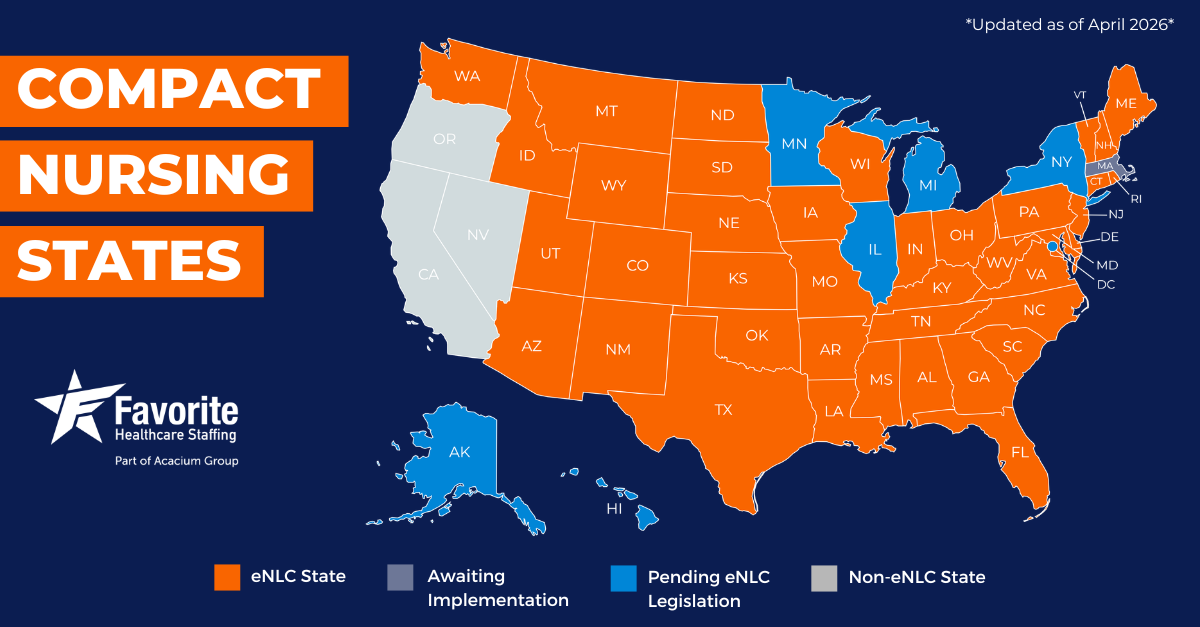
Currently, more than 40 jurisdictions participate in the NLC. These compact states for nursing include:
|
Alabama |
Maine |
Pennsylvania |
|
Arizona |
Maryland |
Rhode Island |
|
Arkansas |
Mississippi |
South Carolina |
|
Colorado |
Missouri |
South Dakota |
|
Connecticut |
Montana |
Tennessee |
|
Delaware |
Nebraska |
Texas |
|
Florida |
New Hampshire |
Utah |
|
Georgia |
New Jersey |
Vermont |
|
Idaho |
New Mexico |
Virginia |
|
Indiana |
North Carolina |
West Virginia |
|
Iowa |
North Dakota |
Washington |
|
Kansas |
Ohio |
Wisconsin |
|
Kentucky |
Oklahoma |
Wyoming |
|
Louisiana |
|
|
Want the latest list and more information about eligibility? Check out our guide to compact states for nursing.
What states are not compact states for nursing?
The states and territories currently that do not participate in the NLC include:
- Alaska
- California
- Hawaii
- Illinois
- Michigan
- Minnesota
- Nevada
- New York
- Oregon
Washington, D.C. is also outside the compact. Some states and territories are in a slightly different category. Massachusetts has approved NLC participation but has not fully implemented it yet, Guam is partially implemented, and the U.S. Virgin Islands has enacted the NLC but is still waiting to put it into effect.
For nurses, the main takeaway is this: compact privileges only apply in states where the NLC is fully active. If you want to work in a non-compact state, or a state where compact privileges are not yet active, you’ll generally need to apply for that state’s nursing license through its board of nursing. Depending on your situation, that may mean applying by examination or licensure by endorsement. Because compact participation can change, always check your state’s board of nursing before accepting an assignment or starting the licensing process.
So, is Illinois a compact nursing state?
No, Illinois is not a compact nursing state. If you're licensed in Illinois and want to practice in another state, you'll usually need to obtain a license in the state where you plan to work, unless that state's licensing requirements provide another pathway.
Likewise, nurses moving to Illinois from a compact state must still obtain an Illinois nursing license before practicing there. While Illinois lawmakers have discussed joining the NLC in recent years, the state has not enacted legislation to become a member.
What this means for nurses in Illinois who want to work across state lines
Illinois' non-compact status doesn't limit your career opportunities, but it can mean a few extra steps if you want to practice outside the state. Since Illinois is not part of the Nurse Licensure Compact (NLC), you'll typically need to apply for licensure by endorsement in each state where you plan to work.
Compared to nurses living in compact states, Illinois nurses may experience:
- Longer licensing timelines before starting a new position
- Additional application fees
- More paperwork for each state license
- Less flexibility when accepting last-minute travel assignments
For travel nurses and per diem professionals, planning ahead becomes especially important. Applying for licenses early can help prevent delays when exciting opportunities become available.
If you're interested in working across state lines, consider these tips:
- Research each state's licensing requirements before applying
- Begin the endorsement process as early as possible
- Keep track of renewal dates for every active nursing license
- Work with a staffing agency like Favorite that understands state licensing requirements and can help guide you through the process
If you're relocating permanently, establishing residency in a compact state may eventually make you eligible for a multistate license, provided you meet all NLC requirements. Even without compact privileges, Illinois nurses can still build successful travel, per diem, and interstate nursing careers with the right preparation.
What this means for nurses who want to work in Illinois
Unlike compact states, Illinois requires every nurse practicing in the state to hold an Illinois nursing license. If you're coming from another state, including a compact state, you'll need to apply for Illinois licensure by endorsement before you can begin working.
While this adds an extra step, it doesn't mean opportunities are limited. Illinois continues to offer strong demand for nurses in hospitals, outpatient clinics, long-term care facilities, and specialty settings throughout the state.
To help avoid delays, it's a good idea to:
- Apply for your Illinois nursing license as early as possible.
- Gather any required documentation before submitting your application.
- Work with a staffing agency that understands Illinois licensing requirements and can help guide you through the process.
Whether you're relocating permanently or accepting a travel assignment, planning ahead can help you start your next role.
FAQs
Can Illinois nurses work in other compact states?
Yes, but not with an Illinois license alone. Since Illinois is not a compact state, nurses must obtain the appropriate license for the state where they want to practice, typically through licensure by endorsement.
Is Illinois a good state for travel nurses?
Illinois can be a great destination for travel nurses thanks to strong demand and high-paying opportunities in major healthcare systems, especially in cities like Chicago. Just remember, you'll need an Illinois nursing license before accepting an assignment.
Can new nursing graduates in Illinois apply for a multistate license?
No, new nursing graduates in Illinois cannot apply for a multistate license because Illinois is not part of the NLC. New graduates in Illinois receive a single-state license after meeting state licensing requirements and passing the NCLEX rather than a multistate license.
Why is Illinois not a compact nursing state?
Illinois has not passed legislation to join the NLC. While proposals have been introduced over the years, the state currently remains outside the NLC.
Can I use my Illinois RN license in another state?
Generally, no. An Illinois RN license authorizes you to practice in Illinois. If you want to work in another state, you'll usually need to obtain that state's nursing license before beginning practice.