

Have you ever thought about what it might be like to travel to different states as a nurse and not have to deal with getting several different licenses to practice? Thanks to the Nurse Licensure Compact (NLC), nurses can practice across state lines without having to apply for multiple licenses.
This blog will give you a better understanding of the benefits of a compact nursing license, which states are compact license states, NLC requirements, and more. Let's take a closer look at what a compact nursing license is and how to apply for one.
Who this NLC guide is for
This guide is especially helpful for:
- Travel nurses
- Nurses planning to relocate
- Telehealth nurses
- New graduates evaluating licensure options
Table of contents
- What is a compact state nursing license?
- What are the benefits of a compact state nursing license?
- What are compact nursing states?
- Common misconceptions about compact licenses
- Compact state nursing license requirements
- How to apply for a compact nursing license
- Compact nurse license application FAQs
- Quick compact nursing license facts
What is a compact state nursing license?
A compact state nursing license allows nurses to practice across participating states without needing a state-specific license. The NLC agreement allows you to hold a single-state license or a compact state license (also known as a “multistate license”).
For a nurse’s license to be valid under the NLC, it must be issued by a participating state. Some participating states have additional requirements, so it’s important to check with the state board of nursing (BON) before traveling across state lines for work. For more information regarding this rule change, please visit www.nursecompact.com.
Quick compact nursing license facts
- Registered nurses (RNs), licensed practical nurses (LPNs), and licensed vocational nurses (LVNs) who meet the uniform licensure requirements are eligible for a multi-state license in NLC states.
- The NLC allows nurses to easily practice across borders in other compact states. This makes it easier for nurses to quickly respond and practice nursing during natural disasters in other NLC states.
- Over two million nurses live in NLC states and are able to provide care in other NLC states.
- Only nurses who declare a compact state as their primary state of residence (PSOR) may be eligible for a multistate license.
- With a multi-state license, nurses can also practice telehealth in all NLC states.
- Easily check whether your license is “multi-state” or “single state” using the Nursys® QuickConfirm tool.
- Effective January 2, 2024, the NLC implemented a new residency rule requiring nurses to apply for their multistate license in their new home state within 60 days of moving.
What are the benefits of a compact nursing license?
Convenience: The biggest benefit of the NLC as a travel nurse is convenience. When you have a multi-state license, you don’t have to spend extra time filling out paperwork and applying for individual state licenses in each place you want to work.
Reduced spending on fees: When you apply for a single-state license, fees are often associated not only with the application, but with the actual license as well. When you have a multi-state license, you don’t have to worry about spending additional time and money when you want to work in a different state than the one you live in.
Improved care: Another added benefit is that it makes it quicker for hospitals and medical facilities to hire qualified personnel from out-of-state locations. This agreement has resulted in better access to quality healthcare professionals across all member states, making it highly beneficial for both patients and healthcare providers.
Enhanced uniformity across states: NLCs create uniformity across all participating states’ nursing regulations by setting certain standards that all states adhere to. This ensures that all members are held accountable no matter which state they happen to be working in.
Telehealth flexibility: A compact nursing license also allows nurses to provide telehealth services to patients located in other compact license nursing states, expanding remote work opportunities.
Faster hiring and onboarding: Because your license is already valid in multiple states, you can start new roles more quickly, often without the delays that come with state-by-state licensing. This makes it easier to pick up shifts or accept assignments on short notice.
Access to more job opportunities: Holding a compact nursing license instantly expands your job market, giving you access to roles in all participating compact nursing states. This can lead to more consistent work and a wider range of settings and specialties.
What are compact nursing states?
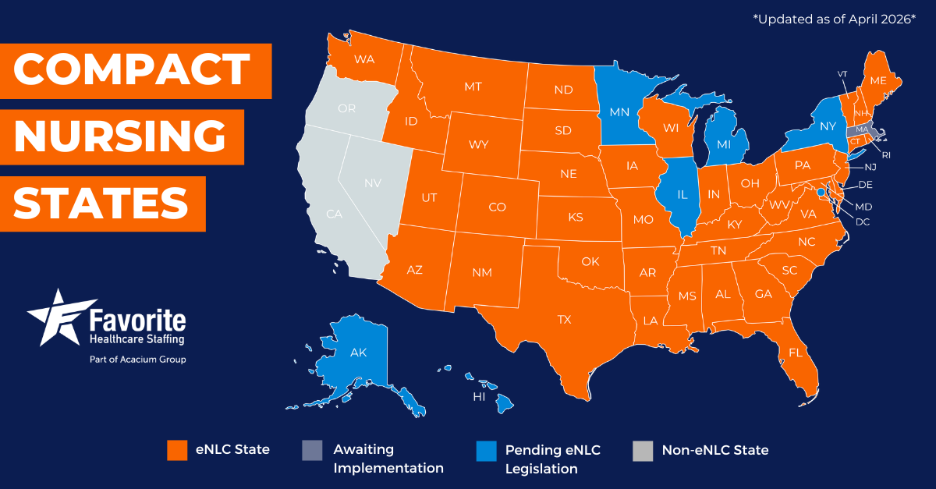
NLC States
|
Alabama |
Maine |
Pennsylvania |
|
Arizona |
Maryland |
Rhode Island |
|
Arkansas |
Mississippi |
South Carolina |
|
Colorado |
Missouri |
South Dakota |
|
Conneticut |
Montana |
Tennessee |
|
Delaware |
Nebraska |
Texas |
|
Florida |
New Hampshire |
Utah |
|
Georgia |
New Jersey |
Vermont |
|
Idaho |
New Mexico |
Virginia |
|
Indiana |
North Carolina |
West Virginia |
|
Iowa |
North Dakota |
Washington |
|
Kansas |
Ohio |
Wisconsin |
|
Kentucky |
Oklahoma |
Wyoming |
|
Louisiana
|
|
|
States with partial implementation
When states have partial implementation of the NLC, it means that nurses with compact state licenses from other participating states can practice in that state. However, nurses who are residents in partially implemented states can't yet apply for compact state licenses. This is because you can’t apply for and obtain your compact state licenses unless you live in a participating state.
-
Guam
NLC enacted and awaiting implementation
- Massachusetts
- U.S. Virgin Islands
States with pending NLC legislation
Several states are currently in the process of joining the NLC but need pending legislation to pass before they can become a compact nursing state. The following states have pending legislation:
- Alaska
- Hawaii
- Illinois
- Minnesota
- New York
- Washington D.C.
- Michigan
California, Nevada, and Oregon are not currently compact license states and do not currently have any pending legislation to join the NLC.
Land your next interview with our helpful tips
Read our blog to discover common nursing interview questions and answers, preparation tips, and more.
Common misconceptions about compact licenses
Despite the growing popularity of the NLC, there are still several common misconceptions that can cause confusion for nurses exploring multistate licensure. Here are some of the most frequent misunderstandings:
“A compact license lets me work in any state.”
Truth: A compact nursing license only allows you to practice in other participating compact states. If a state is not part of the NLC, you’ll still need to apply for a single-state license there.
“I can apply for a compact license in any state I choose.”
Truth: You must apply through your PSOR. Even if you plan to work elsewhere, your compact license must be issued by the state where you legally reside.
“If I have a compact license, I don’t need to follow other states’ rules.”
Truth: While your license is multistate, you’re still required to follow the nursing practice laws and regulations of the state where the patient is located. Each state’s scope of practice still applies.
“Compact licenses are only for travel nurses.”
Truth: While travel nurses benefit greatly, compact licenses are also valuable for telehealth nurses, per diem staff, and nurses living near state borders who may work in multiple states.
“I can keep my compact license if I move to a non-compact state.”
Truth: If you move to a non-compact state, your multistate license will convert to a single-state license, and you’ll need to apply for new licensure if you want to practice elsewhere.
“Getting a compact license is a separate application.”
Truth: In most cases, there isn’t a separate “compact license” application. When you apply for licensure in your home state and meet all uniform licensure requirements, you may be issued a multistate license automatically.
“All nurses automatically qualify for a multistate license.”
Truth: Not all nurses are eligible. You must meet specific requirements, including background checks, education standards, and a clean disciplinary record, to qualify for a compact license.
Compact state nursing license requirements
Nurses interested in getting their compact state nursing license will need to meet the following uniform licensure requirements:
- Meet your state of residence (home state) licensure requirements
- Graduated from a board-approved program or graduated from an accredited international education program
- Passed an English proficiency exam (only applies to graduates of an international program not taught in English)
- Passed the NCLEX-RN or NCLEX-PN
- Hold an active license or be eligible to hold one without active discipline
- Submitted your fingerprint for a background check
- Has not faced any criminal charges or been convicted
- Has no convictions in relation to the nursing field
- Is not currently participating in a different program
- Is required to disclose if they are in a different program
- Has a valid Social Security Number in the United States
How to apply for a compact nursing license
If you meet the uniform licensure requirements and are ready to apply for a compact nursing license, the process begins with your PSOR. You must apply through your state’s BON, as compact privileges are only issued from the state where you legally reside.
To get started, visit the NLC website and select your state to be directed to the correct BON application page. From there, you’ll typically need to:
- Complete an online application with your personal and professional details
- Pay the required application and licensing fees (these vary by state)
- Submit proof of residency (such as a driver’s license, voter registration, or tax documents)
- Undergo a criminal background check
- Verify your nursing education and, if applicable, your current license
If you already hold an active, unencumbered RN or LPN/LVN license in your PSOR, you may be eligible to upgrade to a compact license rather than applying for a new one.
Once your application is submitted, the BON will review your information to ensure you meet all eligibility criteria. Processing times can vary depending on the state and whether additional documentation is required. You’ll be notified once a decision has been made, and if approved, your license will grant you the ability to practice in all other compact states without needing additional licenses.
If you have questions at any stage, it’s best to contact your BON directly, as they can provide the most accurate and up-to-date guidance.
Where can I apply for a compact nurse license?
To apply for your license, you can visit the NLC website and fill out an application through your BON. To get started, simply select your state in the drop-down menu and go from there.
Can I still get a compact license if I don’t live in a compact state?
No, to get a multistate license, you need to have declared residency in a compact state.
How can I tell if I have a compact nursing license or not?
To check if you have a single or multi-state license, you can visit the NCSBN website to confirm. Some people automatically assume they have a compact license if they applied for their state’s license while living in a compact state.
What is the application fee?
The fee to get your license varies by state. To check your state’s fee, you can check your board of nursing website.
Can I transfer my license if I move to another compact state?
Yes, if you move from one compact state to another compact state, you’ll want to apply for licensure by an endorsement through your new state’s BON.
How can I transfer my license if I move to a non-compact state?
To continue working with your current license, you’ll need to apply for licensure by endorsement. Next, you need to apply for licensure in your new residential state. This will then convert your multi-state license to a single-state license. If you want to work in a different state from your residential state, you’ll need to apply for a single-state license there as well.