

In today’s competitive job market, a strong resume is more important than ever. Even in high-demand fields like healthcare, landing your ideal role can come down to how professional, put together, and compelling your resume appears to employers.
In this blog, we’ll walk you through everything you need to know about how to create a sonography resume that sets you apart from other candidates. We’ll also provide real-world resume examples and eye-catching templates that will help you rise above the competition.
Table of contents
- Understanding the basics
- What to include in your sonographer resume
- What to avoid in your resume
- Resume tips
- Sonographer resume example
- Sonographer resume template
- Final acknowledgements before submitting
-
Start searching for open sonographer jobs with Favorite
Understanding the basics
Because so many people are applying for roles as of late, you want your sonographer resume to be clear and concise. It should be about one page long as employers often scan candidates' resumes for only 30 seconds. If you have ample experience, education, and awards, then you can make it two pages if you must, but no more than that.
Other formatting suggestions you’ll want to implement into you resume include:
Font
Times New Roman, Arial, or Calibri for easy readability. Avoid any fonts that might look whimsical or unprofessional.
Font size
For your name, you’ll want it to be 18-22 points, based on the font you choose. Headings and subheadings should be 14-16 points, and the body text should be 10-12 points.
Margins
For an easy-to-read resume, choose the standard one-inch margin.
Bullet points
When outlining details like your skills, previous responsibilities, or awards, always use bullet points. This helps keep your information clear, concise, and easy to read.
File format
When saving your resume to send to potential employers, choose the PDF format. This ensures your layout and formatting stay intact across different devices and operating systems, presenting your resume exactly as intended.
What to include in your sonographer resume
As far as content goes, you’ll want to include each of the following sections in your resume:
Your name, contact information, and location
Of course, you’ll want to add in your first and last name. Your middle name or initial is optional but might be recommended if you have a common first and last name. Additionally, include your phone number, email address, and city and state on your resume.
A summary section
In this section, you have the opportunity to talk a little bit about yourself. Consider including:
- Your career objectives
- Your goals
- How long you’ve been in the field
- What interests you
This will give employers a better idea of what you’re looking for in a new job and what they can expect from you.
Experience you have
Arguably the most important section of your sonographer resume is your experience. This is where you showcase the skills and accomplishments you’ve built throughout your career.
Start by listing your most recent role at the top, then work backward so your employment history appears in reverse chronological order. For each position, include:
- Your job title
- The duration of your employment
- The hospital or facility’s name
- Its location (city and state)
Once that’s in place, add bullet points highlighting your key responsibilities and accomplishments, especially those that closely align with the role you’re applying for. Consider including details such as the trauma level of each hospital, the imaging machines you have experience with, and your charting experience. These specifics will help employers to quickly see how your background meets their needs.
Your education
The section that should come next is your academic background. Here, you’ll want to include:
- The universities or institutes you attended
- Where they’re located
- The degree you earned
- Your major and minor
- The years you were enrolled
- Your grade point average (GPA)
A general rule of thumb is to only mention your GPA if it was a 3.5 or higher.
Any licenses or certifications
For healthcare professionals, it’s especially important to include this section. Be sure to list all relevant credentials you've earned, confirming that none are expired. For each certification or license, include:
- The title
- The issuing organization
- The date you received it
- The date it expires on
This not only demonstrates your qualifications but also reassures employers of your current and active status in the field.
Skills that relate to the job you’re applying for
By adding in skills related to the sonography job you’re applying for, this gives you a good chance to include keywords that employers are looking for within your resume. If you’ve submitted your resume on LinkedIn or another common job platform, adding key skills will also help match you with jobs that are the best fit.
Any honors and awards
If you've received any honors or awards during your academic journey, clinical rotations, or professional career, showcase them. Whether it's a recognition for academic excellence, outstanding performance during clinicals, or commendations from your workplace, these achievements help set you apart from other candidates.
What to avoid in your resume
When writing up your sonography resume, there are a few things you’ll want to avoid. We recommend excluding the following:
- Graphics, pictures, and colors
- Typos
- Outdated or irrelevant information
- Unprofessional language
- An unprofessional email address
Learn more about other sonography roles
Explore the job outlook, salary trends, and career growth opportunities for ultrasound technicians in our blog.
.jpeg)
Resume tips
One of our most important tips when applying for sonography jobs is to customize your resume for each job and facility. While it may be tempting to send the same resume to multiple employers, doing so can make your application feel generic and less aligned with the specific role you're targeting. Each healthcare facility has its own priorities, patient population, and work environment.
For example, if you're applying to a hospital offering a permanent placement, your resume should emphasize long-term commitment, consistency, and depth of experience.
Another important consideration to keep in mind is to use keywords mentioned in the employer's job description. Many healthcare employers use applicant tracking systems (ATS) to screen resumes, so including keywords will help your resume to pass automated filters and highlight that you're a strong match for the role.
Sonographer resume example
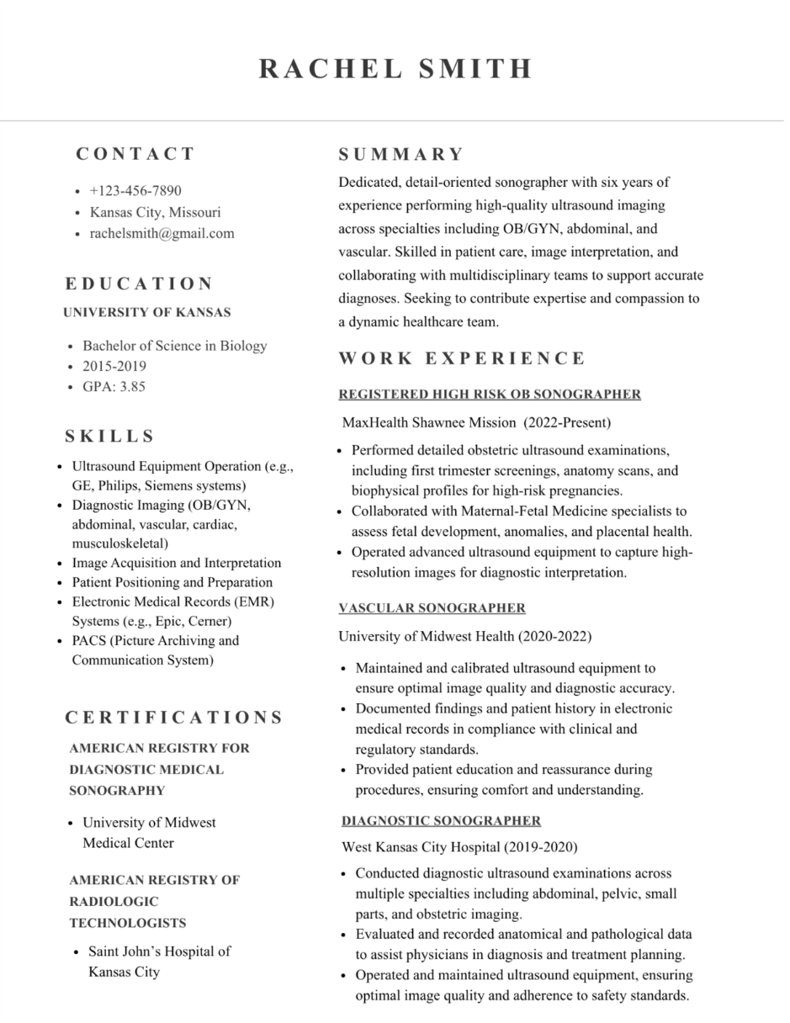
Sonographer resume template
We’ve included a link to the resume template featured in the previous example. If you’re updating your resume, we recommend using this template to create a polished, professional document that highlights all your skills and qualifications, helping you to stand out from other applicants.
Final acknowledgements before submitting
Before submitting your sonography resume to any potential job openings, be sure to proofread it several times. You can also run it through a grammar checker like Grammarly to make sure you didn’t miss any typos. It may also benefit you to have a family or friend read through it, as it’s always a good idea to get a second person’s perspective.
Once you’ve done all of these steps, you’re ready to start applying for jobs!
Start searching for open sonographer jobs with Favorite
We hope this blog has given you a better understanding of what a sonographer resume should include and how to stand out from other candidates.
If you’re looking to start your career with Favorite, search for our open sonography jobs today.
Once you’ve started to apply and land interviews, you’ll also want to read our blog on common interview questions and answers for healthcare professionals.
Get started with Favorite
Whether you're looking for short or long term roles, we have the job options to fit your goals and lifestyle. Browse our open positions today.
%20(1)%20(1)-1.png?width=1200&height=581&name=AdobeStock_213032477%20(2)%20(1)%20(1)-1.png)